Marc Jacobs is a New York fashion label that spent almost thirty years inside the world’s biggest luxury group. Its best-known product, though, is no handbag or coat but a sweet floral in a bottle crowned with white daisies, a perfume so sunny that it borders on innocence.
How did a New York label end up with LVMH?
Marc Jacobs and his business partner Robert Duffy set up the company in the mid-1980s, and the first collection under the Marc Jacobs label came out in 1986. The label grew into a New York fixture, selling clothes and bags first and, later, a great deal of perfume.
In 1997 LVMH bought a majority stake in the brand, the same year Jacobs became the first creative director of Louis Vuitton. In May 2026 LVMH agreed to sell Marc Jacobs to a 50/50 joint venture of WHP Global and G-III Apparel Group, with each partner putting in up to $425 million.
- 1986
First Marc Jacobs collectionfact
- 1997
LVMH takes a majority stakefact
- 2001
First women's fragrancefact
Simply called Marc Jacobs
- 2007
Daisy launchesfact
Composed by Alberto Morillas
- 2020
Perfect arrivesfact
- 2026
Sale to WHP Global and G-III agreedfact
Coty keeps the fragrance license
Who makes the perfumes?
Coty develops and sells the fragrances under license, and the deal with WHP Global and G-III leaves that license with Coty. In 2023 the partnership was widened to makeup, and a reported extension in November 2026 stretched the term to 40 years.
The early lineup was eclectic: the women’s Marc Jacobs in 2001, a men’s version in 2002, Blush in 2004 and, from 2006, a run of cheerful splash colognes in big bottles with names like Rain, Grass and Cotton.
Why did Daisy change everything?
Daisy arrived in 2007 with strawberry, violet and jasmine over soft musk, and a cap of white flowers that looked more like a hair accessory than a perfume stopper. Alberto Morillas of Firmenich wrote the formula.
It became a franchise. A 2019 WWD report, citing an industry source, put the Daisy family at around $300 million in retail sales a year, and Glossy reported in 2022 that the original was still the bestseller worldwide.
Beyond the daisy patch
The brand has tried plenty of other shapes. Lola (2009) came from Calice Becker and Yann Vasnier, Decadence (2015) came in a bottle shaped like a handbag, and Perfect (2020) took its name from a tattoo on Jacobs’s wrist.
| Fragrance | Year | Style | Good for |
|---|---|---|---|
| Daisy | 2007 | Fruity floral with violet and musk | Everyday, warm days |
| Daisy Eau So Fresh | 2011 | Fresher spin on the original | Summer and offices |
| Daisy Love | 2018 | Newer Daisy, big in the US | Casual wear |
| Perfect | 2020 | Rhubarb, daffodil and almond milk | A change from the Daisy mood |
| Daisy Wild | 2023 | Woody fruity floral | Fans of woodier florals |
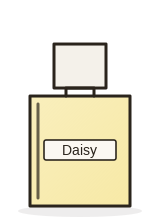
The bottle with the flowers on top
Is Marc Jacobs worth the counter space?
For easy, friendly florals, yes. These scents are built to be liked on first spray, and the Daisy line in particular is a safe gift for someone whose taste you only half know.
Collectors chasing rare materials will look elsewhere. Marc Jacobs sells charm, packaging and a light mood, which is exactly why the flowers keep coming back every season.