Few perfumers have two hits that smell like opposite ends of the same decade. Pierre Bourdon made Kouros, a dense, animalic barbershop scent, in 1981, and then Cool Water, the fresh blue template for a generation of gym bags, in 1988.
Political science, then Roudnitska
Bourdon was born in Paris in 1946 and first studied political science. In 1971, according to his biographies, he met Edmond Roudnitska, the perfumer behind Eau Sauvage and Diorissimo, and turned to perfume.
Frédéric Malle’s house goes further and calls him Roudnitska’s only student. Whatever the exact arrangement, the influence shows in Bourdon’s habit of treating a perfume as a composition with a clear idea, not a pile of nice materials.
Kouros and Cool Water, back to back
| Perfume | Year | House | Mood |
|---|---|---|---|
| Kouros | 1981 | Yves Saint Laurent | Animalic fougère: soap, honey, incense and skin |
| Cool Water | 1988 | Davidoff | Fresh aromatic: mint, lavender and a cold blue air |
| Féminité du Bois | 1992 | Shiseido (Serge Lutens) | Cedar, plum and spice |
| Iris Poudre | 2000 | Frédéric Malle | Aldehydic iris, soft and powdery |
Kouros is the kind of scent people describe with nervous laughter: clean soap on top, something warm and animal underneath. Cool Water went the other way, so clean and airy that it seems to lower the room temperature, and it shaped men’s fragrance for the next decade.
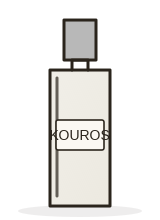

A brawny fougère and a cedar for women
Did he invent the woody feminine?
Not alone. Féminité du Bois (1992), released by Shiseido and later sold under the Serge Lutens name, is credited to Bourdon working with Christopher Sheldrake, Lutens’s longtime perfumer.
It was a striking idea at the time: cedarwood, usually filed under men’s scents, at the center of a perfume for women, softened with plum, spice and beeswax-like sweetness.
A quieter iris for an editor of perfume
Frédéric Malle’s publishing house for perfume put the perfumer’s name on the box, and Bourdon was among the first names he signed. Bourdon’s contribution, Iris Poudre, is an elegant aldehydic floral built around powdery iris.
It shows the Roudnitska side of him: restrained, polished and more interested in balance than in shock. Next to Kouros it seems almost shy, which is part of the fun of reading his credits in order.
The range is the point
Bourdon’s career is a good argument against the idea of a single “signature” smell. A sweaty fougère, a cool aquatic, a woody feminine and a powdery iris share almost nothing on the skin.
What they share is clarity. Each one does a single thing very well, which is probably the most useful lesson anyone could take from a Roudnitska student.