Cashmeran is a marketing triumph in a single word. Nobody can smell cashmere, yet the name tells you exactly what to expect: something soft, warm and expensive-feeling, worn close to the body. The molecule mostly delivers on the promise, which is rarer than it sounds.
Named after a sweater, built in a lab
Cashmeran is the trade name for a ketone with the unwieldy chemical shorthand DPMI. It came out of research at International Flavors & Fragrances in the 1970s, where the chemist John Hall is credited with it, and it grew from cheap chemical tweaks to indane-type structures.
At room temperature it is a white solid that melts just above it. The name was chosen to evoke the softness of cashmere, and perfumers have been using that word to sell it to each other ever since.
Musky, woody, a little dusty
Reference descriptions list spicy, musky, woody and clean facets, with fruity, balsamic and vanilla shading underneath. In plain terms: a warm wool scarf, a freshly sharpened pencil and skin that has just come out of a clean shirt.
It sits low in a composition and blurs edges rather than announcing itself. That makes it the olfactory version of a soft-focus lens.
Where perfumers hide it
Most of the time you meet Cashmeran inside a bigger idea. Mugler Alien is the clearest case on this site: its official pyramid has just three entries, and “cashmeran wood” is one of them, laid between solar jasmine and white amber.
Reference sources also credit it in YSL Black Opium, Carolina Herrera Good Girl and Byredo Blanche. Escentric Molecules went further and bottled it alone as Molecule 05, and Vilhelm Parfumerie lists it in its Flashpoint.
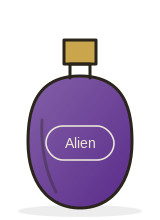
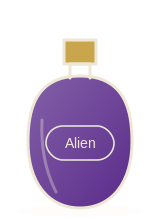
Alien lists cashmeran wood as one of only three notes
Cashmeran at a glance
| Question | Answer |
|---|---|
| Natural or synthetic? | Synthetic, made in the lab |
| Chemical family | An alicyclic ketone (indanone) |
| Smell | Musky, woody, softly spicy, clean |
| Role in a formula | Base and heart: warmth, volume, a blurred finish |
| Strength | Used at low levels, around 2% |