Francis Fabron wrote the perfume Hannibal Lecter sniffs on Clarice Starling and the one Hubert de Givenchy made for Audrey Hepburn. Two pop-culture landmarks, one nose, and yet nobody seems to have written down when he was born.
What do we know about Francis Fabron?
Less than his perfumes deserve. He was a French perfumer working from the late 1940s, and the encyclopedic sources call him “Francis Fabron of Roure,” the Grasse materials house that supplied many couture perfumes of the period. Even the French retailer Tendance Parfums admits his training is poorly documented.
There is no English Wikipedia page for him, no published interview and no reliable birth or death date. What survives is a short list of credits, plus the perfumes themselves.
The credits, ranked by evidence
Here is every perfume we found attached to his name, sorted by how solid the attribution is. “Strong” means the credit appears in several independent references, including Wikipedia or the brand’s own history.
| Perfume | House | Year | Source strength |
|---|---|---|---|
| L’Air du Temps | Nina Ricci | 1948 | Strong: Wikipedia, Bois de Jasmin, Tendance Parfums |
| L’Interdit (original) | Givenchy | 1957 | Strong: Bois de Jasmin, Tendance Parfums, Givenchy’s own story |
| Baghari | Robert Piguet | 1950 | Good: Now Smell This, Persolaise, Bois de Jasmin |
| Monsieur de Givenchy | Givenchy | 1959 | Good: Bois de Jasmin plus several databases |
| Le Dix | Balenciaga | 1947 | Moderate: Bois de Jasmin and Perfume Intelligence |
| Vétyver | Givenchy | 1950s | Thin: Bois de Jasmin |
| Capricci | Nina Ricci | 1960s | Thin: one list on Now Smell This |
L’Air du Temps: carnation with a peace sign
Fabron built L’Air du Temps with Robert Ricci, son of the house’s founder, in 1948. It is a spicy floral: clove-scented carnation on top, a soft bouquet of rose, jasmine and gardenia, then creamy sandalwood. A heavy dose of benzyl salicylate, unusual at the time, gives it a hazy, sun-cream glow.
The Lalique bottle with two doves arrived a few years after the launch and made it one of the most recognizable flacons on any dresser. Decades later Thomas Harris put it in Lecter’s mouth, which we unpack in our Hannibal Lecter story.
The first L’Interdit, a perfume for one client
Nine years on, Hubert de Givenchy asked Fabron for a private scent for Audrey Hepburn. The 1957 L’Interdit is remembered as a powdery aldehydic floral, with violet and earthy orris over a soft base. It is a lighter cousin of the postwar powder style rather than a copy of Chanel No. 5.
The name and Hepburn’s role in its launch are covered in our Audrey Hepburn piece. Two years later Fabron gave Givenchy its first masculine, Monsieur de Givenchy.
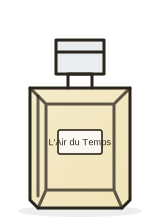
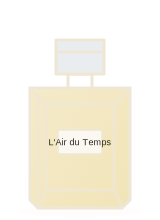
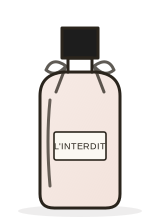
L'Air du Temps is still his; today's L'Interdit is a 2018 rewrite that kept the name
- 1947
Le Dix for Balenciagafact
Credited to him by two references.
- 1948
L'Air du Temps for Nina Riccifact
- 1950
Baghari for Robert Piguetfact
Reorchestrated in 2006 by Aurélien Guichard.
- 1957
L'Interdit for Givenchyfact
Made first for Audrey Hepburn.
- 1959
Monsieur de Givenchyfact
Why his name stays in the footnotes
Fabron belonged to a generation when the couturier’s name went on the bottle and the supplier’s perfumer stayed backstage. Germaine Cellier, a Roure contemporary, became famous partly because her personality leaked into the record. Fabron’s did not.
His work, though, is easy to find. L’Air du Temps has stayed in production since 1948, so a bottle from any department store is the closest thing to a biography he left behind.