In this story · 8 parts
- What does Lecter smell on Clarice?
- Is the scene the same in the book and the film?
- What does L’Air du Temps smell like?
- What does the perfume say about Clarice?
- Could a human nose do what Lecter does?
- Where else does Lecter’s nose show up?
- Should you wear L’Air du Temps?
- The verdict: real perfume, fictional nose
The scariest compliment in film history is about a moisturizer. Hannibal Lecter meets Clarice Starling, breathes in, and correctly names her skin cream and her perfume.
It’s the moment you realize the glass between them isn’t enough. It’s also, for perfume people, a surprisingly precise bit of product placement. Here’s what he says, what she wasn’t wearing, and why that perfume fits so well.
What does Lecter smell on Clarice?
Clarice is an FBI trainee sent to interview him at the Baltimore hospital for the criminally insane. He stands close to the glass, inhales, and names two things.
The first is her skin cream, Evyan, from an American perfume company best known for White Shoulders. The second is L’Air du Temps, which, he notes, she sometimes wears.
Then comes the sting: she isn’t wearing it today. He isn’t just reading her; he’s telling her he knows her habits well enough to spot an absence.
Is the scene the same in the book and the film?
Mostly. Jonathan Demme’s 1991 film follows Thomas Harris’s 1988 novel closely in the first meeting, and the perfume beat comes from the book. Here’s how the two compare in broad strokes.
| Novel (1988) | Film (1991) | |
|---|---|---|
| Who’s speaking | Lecter, during their first interview | Anthony Hopkins as Lecter |
| Products named | Evyan skin cream and L’Air du Temps | The same two |
| The twist | She isn’t wearing the perfume that day | Kept, and delivered with a long pause |
| How it lands | One of many details of his perception | A signature moment, endlessly quoted |
| Purpose | Shows his senses and his intrusiveness | Shows the same, in close-up |
Screen adaptations often trim this kind of detail. Here the screenwriter, Ted Tally, kept it, and the film’s performance turned a line of dialogue into a cultural reference.
What does L’Air du Temps smell like?
L’Air du Temps was created by perfumer Francis Fabron for Nina Ricci, working with the founder’s son, Robert Ricci. Its famous bottle, with two glass doves on the stopper, arrived in 1951 from Lalique, three years after the launch.
It’s a spicy floral. Carnation and clove give it a gentle peppery warmth, then rose, jasmine, gardenia and iris make it soft and powdery, with sandalwood underneath. It was also an early heavy user of benzyl salicylate, a material that gives a creamy, sunny, slightly floral haze.













As described in reference sources; the formula has been adjusted over the years
- Spice
- none peppery
- Powder
- crisp powdery
- Sweetness
- dry sweet
- Loudness
- skin scent room-filling
Reflects how the fragrance is generally described, not a test of a specific bottle
Fragrances in this story
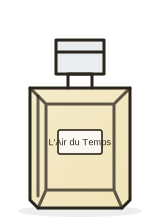
Affiliate link: as an Amazon Associate we earn from qualifying purchases, at no extra cost to you.
What does the perfume say about Clarice?
Harris never explains the choice in the text, and we couldn’t find him discussing it, so treat this part as our reading.
By the late 1980s, L’Air du Temps was a well-known, widely available classic: pretty, affordable, a little old-fashioned. It’s the kind of perfume a young woman might own because a mother or aunt wore it, or because it was a safe first “real” bottle.
That fits Clarice perfectly. She’s a working-class trainee trying to look polished on a government budget. Lecter’s comment reads her class, her ambition and her nerves in a single sniff, which is exactly why it’s so uncomfortable.
The skin cream detail sharpens the point. Evyan was an everyday American brand, not a Paris couture house. He isn’t flattering her taste. He’s taking inventory.
Could a human nose do what Lecter does?
Partly. Humans are better smellers than our reputation suggests. Research suggests we can tell apart an enormous number of odor mixtures, and with training people get much better at naming what they smell.
Perfumers are the proof. They spend years learning hundreds of raw materials until they can pick out a single note in a finished blend, and many can name famous perfumes on a blotter.
Recognizing a classic, widely sold perfume like L’Air du Temps on a person standing close to you is well within reach of a trained nose. Plenty of perfume lovers could do it, especially with a scent they grew up around.
Two things push Lecter into fiction. The first is the skin cream: lightly scented creams are faint and generic, and naming the brand would be a remarkable feat. The second is the absence. Knowing she “sometimes” wears a perfume she isn’t wearing implies he has read her from traces in her hair or clothes, which is a novelist’s flourish rather than a lab result.
Where else does Lecter’s nose show up?
His sense of smell is a running trait across the stories. In the novel Hannibal (1999), Harris sends him to Florence and into the Officina Profumo-Farmaceutica di Santa Maria Novella, the centuries-old pharmacy and perfumery, which the novel names and praises for its scent.
The NBC series Hannibal (2013 to 2015) plays it for dark comedy, with Lecter needling Will Graham about his cheap aftershave. Different medium, same message: he can smell what you are.
- 1948
L'Air du Temps launchesfact
Nina Ricci's spicy floral, by Francis Fabron.
- 1988
The Silence of the Lambs (novel)fiction
Lecter names Clarice's cream and perfume at their first meeting.
- 1991
The filmfiction
Anthony Hopkins delivers the "not today" line.
- 1999
Hannibal (novel)fiction
Lecter in Florence, including the Santa Maria Novella pharmacy.
- 2013–2015
NBC's Hannibalfiction
Running jokes about Will Graham's aftershave.
Should you wear L’Air du Temps?
If you like soft, powdery florals with a spicy edge, it’s still sold and still widely available, and it’s a classic worth smelling at least once. Just be aware that formulas have been adjusted since 1948, so it won’t be identical to what a 1980s trainee wore.
A practical note for anyone visiting a high-security hospital: perhaps skip the perfume that day. Clarice was right about that.
The verdict: real perfume, fictional nose
Fact, in the sense that matters. L’Air du Temps is a real perfume, Evyan was a real brand, and Lecter’s line is a real scene in the novel and the film.
What’s fiction is the nose itself. A human can learn to recognize a favorite perfume across a room, but naming someone’s skin cream through a pane of glass is Lecter’s party trick, not ours.