In this story · 7 parts
A girl in a black dress, a pastry and a paper cup, standing at a jeweler’s window at dawn. It’s one of the most famous openings in film, and somehow you can almost smell it.
Almost. Holly Golightly is a character built from surfaces, sunglasses and good lines, but her perfume is never named. So we’re doing what Holly does with most things: improvising with style and hoping nobody checks the paperwork.
Does Holly Golightly wear a named perfume?
No. Breakfast at Tiffany’s gives Holly a cat without a name, a mailbox card announcing that she’s traveling and a habit of losing her key. A perfume bottle isn’t on the list.
The film doesn’t add one either. Blake Edwards’s version is crowded with famous objects (the dress, the sunglasses, the long cigarette holder), but none of them is a scent.
That leaves a gap fans fill with confident lists. Treat them like Holly’s stories about her past: entertaining, and not to be taken as evidence.
What did Audrey Hepburn wear?
This is where the two women need separating. Audrey Hepburn, the actress, had a real and well-documented perfume: L’Interdit, which Hubert de Givenchy had made for her and which went on public sale in 1957.
That story has its own page: Audrey Hepburn and L’Interdit. It’s a fact, backed by the house and decades of reporting.
Holly is a different matter. Givenchy dressed Hepburn for the film, but nothing in the script or the book says the character wears his perfume. Giving Holly L’Interdit would be casting the actress, not the role.
How is book Holly different from film Holly?
The difference matters, because the two Hollys live in different decades and would shop at different counters.
| Book Holly | Film Holly | |
|---|---|---|
| Era | Opens in autumn 1943, wartime New York | The film’s own time, around 1960 |
| Way of life | Lives on gifts from rich men; Capote called her an “American geisha” | Softened, more kooky than calculating |
| Ending | Leaves the country; no love story | A romance and a rain-soaked reunion |
| Mood | Wilder, sadder, harder to pin down | Elegant, funny, gently melancholy |
| Scent logic | Prewar and wartime classics | 1950s Paris, fresh and green |
Capote reportedly wanted Marilyn Monroe for the part, and the novella’s Holly is closer to that image: tougher and more openly a survivor. Hepburn’s Holly is lighter on her feet.
What is our scent-cast for Holly Golightly?
From here on, this is our invention, clearly labelled. We cast each Holly with fragrances that existed in her own setting, then add one modern pick we flag as out of period.
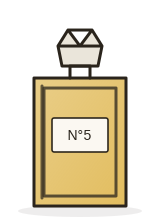
Book Holly: Chanel No. 5 (1921). In the 1940s, No. 5 was already the shorthand for Paris glamour, and a girl reinventing herself from rural Texas into café society would reach for the most recognizable signal in the room. Its aldehydes give that fizzing, champagne-at-breakfast lift.
- Topthe first 15 minutesAldehydes · Neroli · Ylang-ylang · Bergamot · Lemon
- Heartthe next few hoursJasmine · Rose · Iris · Lily of the Valley
- Basewhat stays on skinSandalwood · Vetiver · Vanilla · Musk · Amber
Film Holly: Dior Diorissimo (1956). Edmond Roudnitska’s lily of the valley is green, dewy and a little innocent, which suits Hepburn’s version: early morning, fresh air, a hint of something she isn’t telling you.
Fragrances in this story
Affiliate link: as an Amazon Associate we earn from qualifying purchases, at no extra cost to you.
The runner-up for the film is Nina Ricci L’Air du Temps (1948), a soft carnation-and-gardenia floral. It’s also by Francis Fabron, the perfumer credited with Hepburn’s original L’Interdit, which is as close as we’ll let the actress and the character get.
Which 1950s and 60s perfumes fit?
Holly’s New York is the age of the department-store counter, when a perfume told people what kind of woman you meant to be. Here’s the shortlist we checked against launch dates.
- 1921
Chanel No. 5fact
Ernest Beaux's aldehydic floral, our pick for book Holly.
- 1943
The novella opensfiction
Wartime New York, Holly in a brownstone on the Upper East Side.
- 1948
L'Air du Tempsfact
Nina Ricci's soft spicy floral.
- 1956
Diorissimofact
Roudnitska's lily of the valley, our pick for film Holly.
- 1957
L'Interdit goes on salefact
Audrey Hepburn's real perfume, separate from the character.
- 1958
Capote publishesfact
Breakfast at Tiffany's appears in Esquire and as a book.
- 1961
The filmfact
Hepburn plays Holly, and the dawn opening becomes famous.
Notice how close these dates sit. The film Holly could have owned every bottle on this list; the book Holly only the first one, which is part of why No. 5 suits her so well.
What are the modern alternatives?
Here the period rule goes out of the window, so read this section as pure casting for today.
- Chanel No. 19 (1970): anachronistic, and we’re flagging it plainly, since it launched nine years after the film. Galbanum and iris make it cool, green and a bit aloof, which is Holly behind her sunglasses
- Chanel No. 5 Eau de Parfum: still the most direct line back to Holly’s era
- Diorissimo: still on sale, and still the dawn-on-Fifth-Avenue pick

 Aldehydes
 Neroli
 Ylang-ylang

 Bergamot

 Lemon
 Jasmine
 Rose

 Iris
 Lily of the Valley
 Sandalwood

 Vetiver
 Vanilla
 Musk
 Amber
 Galbanum
- Bergamot
- Neroli
 Hyacinth
- Iris
- Rose
- Jasmine
- Lily of the Valley
- Ylang-ylang
- Vetiver

 Oakmoss
- Sandalwood
 Leather
- Musk
 Cedarwood
If you want one bottle, No. 5 wins. If you want the mood of the opening scene, the sleepy walk home past the shop windows, Diorissimo comes closer.
Why our Holly verdict is a scent-cast
Scent-cast. Capote’s novella and the film never give Holly a perfume. The Audrey Hepburn connection is real but belongs to the actress, whose L’Interdit we cover separately.
Everything else here is our casting, dated so the period picks could have existed in Holly’s world. Wear No. 5 with dark glasses, and save the pastry for the walk home.