Legend has it that Shalimar began as an experiment: Jacques Guerlain tipped a new synthetic vanilla into a bottle of his uncle’s Jicky just to see what would happen. Nobody can prove it, yet the story refuses to die, because it sounds exactly like something the man who made vanilla grown-up would do.
Raised to inherit a perfume house
Jacques Guerlain was born in 1874 in Colombes, near Paris, into the family that had run the Guerlain house since 1828. His uncle Aimé Guerlain, the creator of Jicky, trained him from his teens as an apprentice and successor.
Jacques went on to become the house’s chief perfumer for roughly half a century. He was the most celebrated perfumer the family produced, which in that family is a competitive title.
What does an Impressionist collector bottle?
He was a keen art collector with a taste for the Impressionists. That makes sense once you smell his work: soft edges, hazy light and a lot of mood.
Après l’Ondée (1906) means “after the shower,” and it smells like it: violet, iris and a damp, powdery melancholy. L’Heure Bleue (1912) captures the “blue hour” of dusk in Paris with anise, heliotrope, iris and a soft almond-vanilla base. It is wistful and powdery, the perfume equivalent of a long sigh.
| Perfume | Year | Mood | Built around |
|---|---|---|---|
| Après l’Ondée | 1906 | Damp, powdery melancholy | Violet, iris |
| L’Heure Bleue | 1912 | Dusk in Paris | Anise, heliotrope, iris, almond-vanilla |
| Mitsouko | 1919 | Velvet and moss | Oakmoss, a peach note from “aldehyde C-14” |
| Shalimar | 1925 | Smoky, creamy amber | Bergamot, smoky resins, deep vanilla |
A Japanese heroine and a Mughal garden
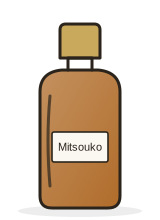
Mitsouko (1919) is a chypre built on oakmoss and a velvety peach note from a molecule nicknamed “aldehyde C-14.” It is named after the heroine of Claude Farrère’s 1909 novel La Bataille, set during the Russo-Japanese War.
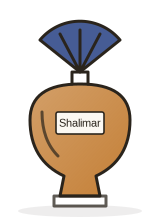
Shalimar (1925), presented at the great Paris decorative arts exhibition that year, is named after the Mughal gardens of Lahore. Bright bergamot, smoky resins and a deep, creamy vanilla made it one of the defining “oriental” perfumes, a style now often called amber.
Six years apart, still on sale
Mitsouko and Shalimar, side by side
The two masterpieces share a bright citrus opening and a floral middle, then part ways completely. Mitsouko sinks into moss and spice; Shalimar into vanilla and smoke.
 Bergamot
 Lemon
 Peach
 Rose
 Jasmine
 Lilac
 Ylang-ylang
 Oakmoss
 Vetiver
 Cinnamon
 Labdanum
 Spices
- Bergamot
- Lemon
 Mandarin
 Iris
- Jasmine
- Rose
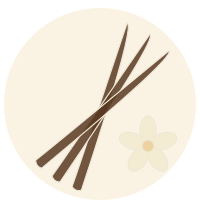 Vanilla
 Tonka Bean
 Opoponax
 Incense
 Leather
How vanilla left the kitchen
Jacques Guerlain showed that vanilla, until then mostly a kitchen ingredient, could be sensual and grown-up when wrapped in smoke, citrus and resin. He also helped define the house’s soft, powdery “Guerlinade” style.
Many of his perfumes are still on sale more than a century later. That is the closest thing perfumery has to a standing ovation.