In this story · 7 parts
- What happens in Perfume, without spoiling the ending?
- How much of the perfumery in the book is real?
- What were Paris and Grasse like for an 18th-century perfumer?
- Could anyone smell like Grenouille?
- Was there an official perfume for the film?
- Which real perfumes smell like the world of the book?
- Our verdict on Grenouille’s perfumery
Most perfumers want to bottle a flower. Jean-Baptiste Grenouille wants to bottle people, and he isn’t fussy about asking first.
Perfume is the only bestselling thriller in which the murder weapon is, in a sense, a distillation apparatus. It’s also one of the best-researched novels about perfume ever written. Here’s where Süskind’s craft is real, where it’s fable, and what the book’s world smells like.
What happens in Perfume, without spoiling the ending?
Grenouille is born in a Paris fish market in 1738, with an extraordinary sense of smell and, strangely, no body odor at all. He grows up unloved, working in a tannery, cataloguing every smell in the city.
He talks his way into the shop of Giuseppe Baldini, an aging perfumer on the Pont au Change who has lost his touch. Baldini’s rival, Pélissier, has a hit scent called Amor and Psyche, and Grenouille copies and improves it on the spot, by nose alone.
From there he heads south to Grasse to learn the techniques that can capture what distillation can’t. That’s where the novel turns from a strange apprentice story into a murder case.
Tom Tykwer’s 2006 film, with Ben Whishaw as Grenouille, Dustin Hoffman as Baldini and Alan Rickman as a worried father, follows the same arc while reworking the tone and some of the plot.
How much of the perfumery in the book is real?
A surprising amount. Süskind did his homework, and most of Grenouille’s tools existed.
| Technique in the novel | Real? | How it worked in practice |
|---|---|---|
| Distillation | Yes | Steam carries aromatic oils out of plant material; works for rose, lavender, citrus peel and many herbs |
| Cold enfleurage | Yes | Delicate flowers are laid on purified fat, which absorbs their scent over days or weeks |
| Hot enfleurage (maceration) | Yes | Flowers are steeped in warm fat or oil, then strained |
| Tincture in alcohol | Yes | Materials soaked in alcohol, the basis of most perfume |
| Copying a perfume by nose | Partly | Skilled perfumers can get close by smell; perfect copies normally need lab analysis |
| Capturing a human’s scent | No | The novel’s leap into fable |
The key insight is Baldini’s lesson: some flowers, such as jasmine and tuberose, don’t survive distillation well. For those, Grasse had enfleurage.
Workers spread purified animal fat on glass frames and laid fresh petals on top, replacing them daily. The fat became a fragrant pomade that was washed with alcohol to free the scent. It was slow, expensive and very real, and it’s what Grenouille adapts for his crimes.
What were Paris and Grasse like for an 18th-century perfumer?
In 18th-century France, perfume and leather were close relatives. Paris perfumers belonged to the same guild as glove makers, because scented gloves were a luxury product: leather smelled bad, and perfume fixed that.
Grasse followed the same path. The town was known for tanning, and its tanners turned to perfuming leather, then to growing and processing flowers. By Grenouille’s era, its fields of jasmine, rose and tuberose were feeding perfumers across Europe.
So the novel’s journey, from a stinking Paris tannery to a Paris perfume shop to the flower fields of Grasse, follows the real route of the trade. Süskind just put a murderer in the middle of it.
Could anyone smell like Grenouille?
No. Everyone has a personal scent, shaped by skin chemistry, bacteria, diet and genes. Dogs can track it; people can often recognize family members by it. A completely odorless human is fantasy.
The opposite gift, an unusually sharp nose, is real but less dramatic. Trained perfumers can recognize hundreds of materials and pick out notes most of us miss, but they work by learning and practice, not by smelling a stranger from across a city.
That’s the book’s trick. It takes a real skill to an impossible extreme, then asks what a person with that gift and no conscience might do with it.
- 1738
Grenouille is bornfiction
In a Paris fish market, in the novel's timeline.
- 1985
Süskind publishes the novelfact
Das Parfum appears in German, then in many translations.
- 1993
Nirvana's "Scentless Apprentice"fact
Kurt Cobain, a fan of the novel, writes a song inspired by it.
- 2006
Tom Tykwer's filmfact
Premieres in Germany, with Ben Whishaw as Grenouille.
- 2006
Mugler's Le Parfum coffretfact
Fifteen scents interpreting scenes from the novel.
Was there an official perfume for the film?
Yes, and it’s one of the oddest fragrance releases of the 2000s. To coincide with the film, Thierry Mugler released Le Parfum, a limited-edition box of fifteen small scents, each interpreting a moment or idea from the novel.
The project came from perfumer Christophe Laudamiel, working with Christoph Hornetz and the Mugler team. The scent names read like chapter titles: Baby, Paris 1738, Boutique Baldini, Amor and Psyché, Jasmin Absolu, plus a final scent called Aura.
Some were wearable perfumes. Others were olfactory scenes, meant to be smelled rather than worn. Fans of Grenouille’s Paris fish market will be relieved to hear the box was not entirely literal.
The set reportedly sold out quickly and is now a collector’s item, so we won’t send you hunting for one.
Which real perfumes smell like the world of the book?
This part is our scent casting, not Süskind’s. Nobody can bottle the novel’s climax, and nobody should try.
What we can bottle is Grasse. The novel’s heart is the white flowers that enfleurage was made for: jasmine and tuberose, heady, creamy and almost too much.






The flowers and materials that drive the novel's perfume scenes
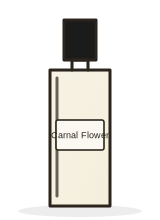
Carnal Flower, by Dominique Ropion for Frederic Malle, is a huge, realistic tuberose with a green, almost dewy edge. It smells like standing in the flower room of a Grasse factory.
Fragrances in this story
Affiliate link: as an Amazon Associate we earn from qualifying purchases, at no extra cost to you.
Fracas, by Germaine Cellier for Robert Piguet, is the classic tuberose bomb from 1948: lush, creamy and dramatic. If Baldini had lived two centuries later, this is what he’d have been jealous of.
Try these if you
- loved the Grasse chapters most
- enjoy big, creamy white flowers
- want a perfume with a story behind it
Skip them if you
- prefer fresh, citrus or clean scents
- find tuberose headache-inducing
- were hoping for the climax in a bottle
Our verdict on Grenouille’s perfumery
Scent-cast. Grenouille and his crimes are fiction. The perfumery around him, from guild workshops to enfleurage frames, is real and carefully researched.
The only official bottles were Mugler’s 2006 box. Everything else here is our casting, chosen to smell like the flowers that made Grasse famous and the techniques Süskind put to such dark use.