Oakmoss is the note that made vintage perfume smell like vintage perfume. It is also the reason your grandmother’s chypre smells different from the bottle sold under the same name today.
Ink, seaweed and a forest after rain
Oakmoss smells dark, damp and earthy, like a forest floor after rain. It has an inky, slightly salty, almost seaweed-like quality, with leathery and woody depth and a faint sweetness.
In a blend it adds a rich, shadowy texture that is hard to fake. It is the velvet lining inside an old coat: you notice it most when it is missing.
Not a moss, and not only on oaks
Despite the name, oakmoss is not a moss. It is a lichen, Evernia prunastri, that grows on oak trees and other trees, harvested mainly in Southern and Central Europe and North Africa. The name just never got the memo.
The lichen is extracted with solvents into a concrete and then an absolute. A related lichen, treemoss, grows on conifers and is used in a similar way.
The backbone of chypre and fougère
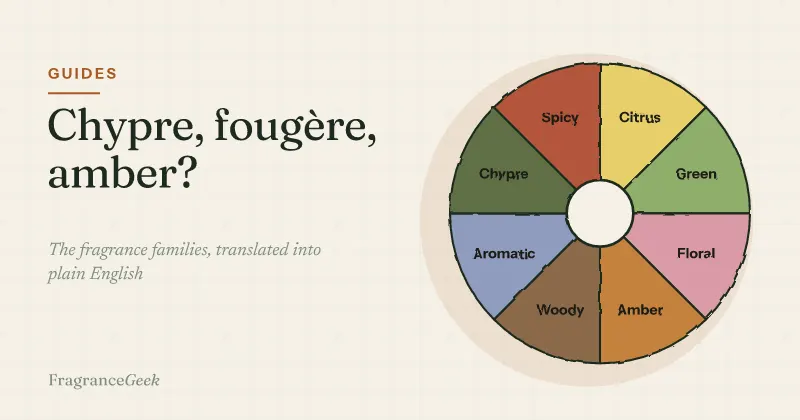
Oakmoss is a base note and the backbone of two big fragrance families. Swap the top and the family changes; keep the moss and the foundation holds.
| Family | Built on | Feels like |
|---|---|---|
| Chypre | Bergamot on top, oakmoss in the base, often with labdanum and patchouli | Peachy, mossy, shadowy classics such as Mitsouko |
| Fougère | Lavender, coumarin and oakmoss | The classic barbershop structure |
Classic chypres and oakmoss-rich fragrances include:
- Guerlain Mitsouko (1919): peachy and mossy, one of the most celebrated chypres
- Dior Diorella (1972): Edmond Roudnitska’s citrusy, green chypre with a mossy base
- Dior Eau Sauvage (1966): Dior describes a chypre accord with oakmoss and patchouli beneath the citrus
- Chanel No. 19 (1970): green galbanum and iris over a mossy, woody base
- Floris No. 89: oakmoss listed in its woody base
Fragrances on this site that list oakmoss
Why vintage chypres smell different: the regulation story
Oakmoss naturally contains atranol and chloroatranol, two compounds identified as strong skin allergens. The International Fragrance Association (IFRA), the industry’s self-regulating body, introduced limits on oakmoss and treemoss extracts. The EU went further.
- 2017
Regulation (EU) 2017/1410fact
Targets atranol and chloroatranol in cosmetics.
- 2019
No new products with themfact
From August 23, 2019, cosmetics containing them could no longer be placed on the EU market.
- 2021
Off the shelvesfact
From August 23, 2021, they could no longer be sold.
The industry responded with specially treated oakmoss extracts with very low levels of these compounds, plus mossy synthetics such as Evernyl. That is why many classics were reformulated. Fans of vintage bottles have opinions about this. Loud ones.